How to Calculate a Cat's Calorie Needs
The cat calorie calculation step by step: resting energy, life stage factors, treats and portions, plus why weight loss in cats must always involve a vet.
PetCred Editorial Team · Updated 8 August 2026 · 7 min read
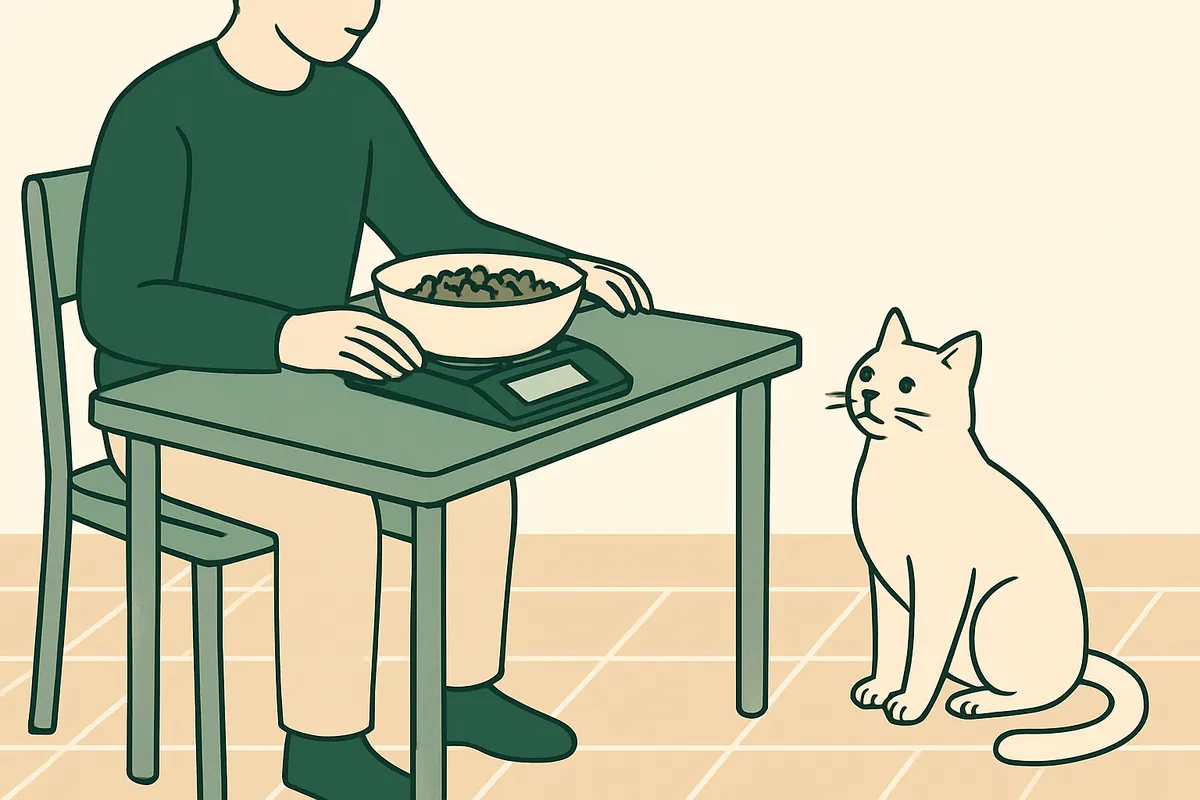
Working out how much a cat should eat starts with the same formula used for dogs, but the numbers that follow are different, and so are the risks. A cat calorie calculation gives you a starting point for a healthy adult cat. It does not replace the vet, and for a cat that needs to lose weight it must never be used without one.
This guide walks through the standard method step by step, with a worked example, then covers the parts that are specific to cats: why fasting is dangerous, why weight loss has to be slow and supervised, and how to turn a calorie number into a plan an owner will actually follow.
This guide is for healthy adult cats and is general education, not veterinary advice. Kittens, pregnant or nursing cats, cats with any medical condition and any cat that needs to lose weight should have their diet set and monitored by a vet.
Why cats need their own calculation
Cats are not small dogs. They are obligate carnivores: they need nutrients that come mainly from animal tissue (such as taurine and preformed vitamin A), and they are adapted to a diet high in protein. They also tend to be less active than dogs of a similar weight, especially indoor and neutered cats, so the multipliers used for dogs overestimate what most cats need.
The other difference is what happens when a cat eats too little. A cat that stops eating, or loses weight too quickly, is at risk of hepatic lipidosis (fatty liver disease), a serious condition that needs urgent veterinary care. This is why a consultant never tells an owner to put a cat on a strict diet, skip meals or fast a cat, and why any weight loss plan belongs to the vet.
Step 1: Work out the resting energy requirement
The resting energy requirement (RER) is the energy the cat uses at rest in a comfortable environment. The standard formula is the same as for dogs:
RER (kcal per day) = 70 × (body weight in kg)^0.75
The exponent means energy needs do not rise in a straight line with weight. You will need a calculator with a power function, or you can cube the weight (multiply it by itself three times) and then take the square root twice. That gives the same result as raising it to the power of 0.75.
Worked example: a healthy, neutered indoor cat weighing 4 kg, at a good body condition.
- 4^0.75 is about 2.83.
- RER = 70 × 2.83 = about 198 kcal per day.
Use the cat's current weight only if the cat is at an ideal body condition. For a cat that is overweight or underweight, the vet decides which target weight to use.
Step 2: Apply a life stage factor
The maintenance energy requirement (MER) is the RER multiplied by a factor for life stage and activity. Commonly used starting factors for cats are lower than those for dogs:
| Cat | Typical starting factor × RER |
|---|---|
| Neutered adult, normal activity | 1.2 |
| Intact adult, normal activity | 1.4 |
| Inactive or prone to weight gain | 1.0 |
| Kitten (growth) | 2.5 |
| Weight loss | Set by the vet |
| Pregnant or nursing | Set by the vet |
Continuing the example: the neutered 4 kg cat.
- MER = 198 × 1.2 = about 238 kcal per day.
Treat this as an estimate. Two cats of the same weight can differ considerably, and published factors vary a little between sources. What matters is what happens to the cat's weight and body condition over the following weeks, not the number on paper.
Step 3: Leave room for treats and extras
A common guideline is to keep treats and extras to no more than about 10% of daily calories. For the example cat, that is around 24 kcal, which is not much: a few small treats can use it up. Ask owners about everything the cat eats, including dental treats, lickable treats, milk products, food from the table and food taken from other pets' bowls. In multi-cat homes, a cat that looks like it is overeating on paper may simply be eating another cat's portion.
For the example, the food allowance after treats is about 214 kcal per day.
Step 4: Turn calories into a portion
Find the calorie content on the food's label. It is often given as kcal per kilogram, per cup, per can or per pouch. If you need help finding it, see how to read a pet food label.
Example with dry food: the food provides 3,600 kcal per kg (these figures are for illustration only; use the real label).
- 214 ÷ 3,600 × 1,000 = about 59 g of dry food per day.
Example with wet food: a pouch provides 70 kcal.
- 214 ÷ 70 = about 3 pouches per day.
Many owners feed a mix of wet and dry food. In that case, decide the wet portion first, subtract its calories and fill the rest with dry food. Weigh dry food on kitchen scales rather than using a cup: with portions this small, a slightly heaped cup can add a meaningful share of the day's calories.
Step 5: Check body condition, then adjust
The calculation gets you close. Body condition tells you whether you are right.
Vets commonly use a 9-point body condition score for cats, where 5 is ideal. At a good condition:
- Ribs can be felt easily under a slight covering of fat, without pressing hard.
- From above, there is a gentle waist behind the ribs.
- The belly has only a small amount of fat. Many cats have a loose flap of skin on the lower belly (the primordial pouch), which is normal and should not be confused with fat.
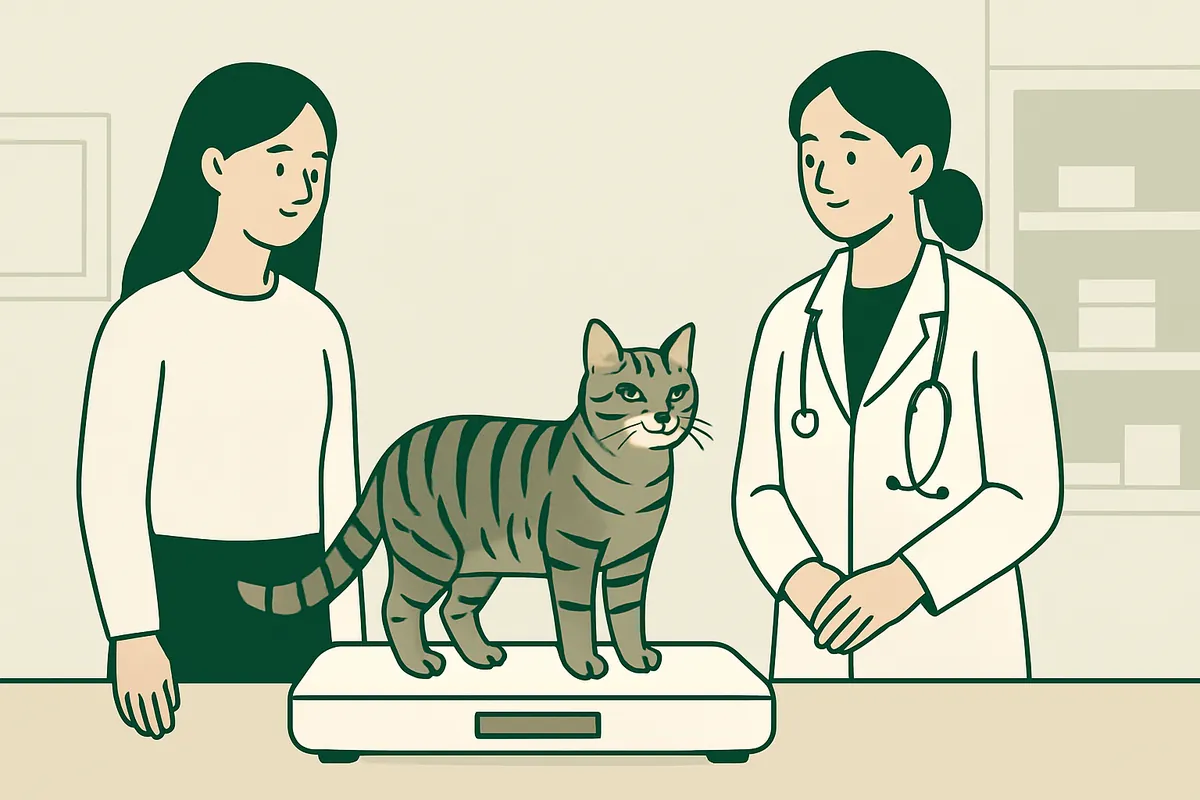
Weigh the cat on the same scales and score its condition every few weeks. If a healthy adult cat is slowly gaining or losing weight at maintenance, adjust the portion in small steps and recheck. If a cat is losing weight without a planned change, is eating less or refuses food, refer the owner to the vet promptly rather than adjusting the portion. Unplanned weight loss in a cat can be an early sign of illness.
Weight loss in cats always involves a vet
Overweight cats are common, and owners often want to fix it quickly. This is where a consultant must be most careful.
- Never fast a cat or cut food sharply. Rapid weight loss or a period of not eating puts a cat at risk of hepatic lipidosis.
- The vet sets the target. The vet examines the cat, rules out medical causes, decides on a target weight and a safe rate of loss, and may recommend a specific diet.
- Slow is the goal. Safe weight loss in cats is gradual and monitored with regular weigh-ins, so problems are caught early.
- Stop and refer if the cat stops eating, becomes lethargic or loses weight faster than the vet planned.
Your role is to support the vet's plan: help the owner measure portions accurately, plan treats inside the allowance, set up feeding in a multi-cat home and keep a simple weight record to share at each check.
Common mistakes
- Using dog factors for cats. They overestimate what most adult cats need.
- Trusting the feeding guide as exact. It is a range for an average cat, not your client's cat.
- Measuring with a cup. Small portions make small errors matter. Weigh the food.
- Forgetting the other cats. Shared bowls make any plan unreliable.
- Treating weight loss as a portion problem only. It is a vet-led plan with regular checks, not a diet the owner runs alone.
- Ignoring a change in appetite. A cat that eats less for more than a day or so needs a vet, not a new food.
Practical feeding tips for owners
Owners do not need the formula. They need a daily amount in grams, split into meals, a treat allowance they can use, and a way to know if it is working. A few ideas help with both weight and behavior:
- Several small meals suit many cats better than one or two large ones.
- Puzzle feeders and scattered food slow eating and add activity, which is useful for indoor cats.
- Separate feeding stations, or microchip feeders, help in multi-cat homes.
- Change foods gradually over about a week to avoid digestive upset and food refusal.
Next steps
Energy needs, body condition scoring and the limits of a consultant's role are core topics in the Pet Nutrition Consultant program. For the dog version of this method, with its own factors, see how to calculate a dog's calorie needs. For a clear picture of when to hand a case to a vet, read pet nutritionist vs veterinary nutritionist, and for the wider career, the guide on how to become a certified pet nutritionist.
You can also try free sample questions from the pet nutrition assessment to see how these topics are tested.
Written by the PetCred Editorial Team and checked against the published curriculum for this program. Laws and requirements change and differ by place: check local rules before relying on anything legal or regulatory here.
Free course
Pet Nutrition Fundamentals: A Free 5-Lesson Course
Five short lessons, a quick check after each, no sign-up. Start now →
More pet nutrition guides
How to Become a Certified Pet Nutritionist: A Practical Guide
What a pet nutrition consultant does, the science to learn, where consulting ends and veterinary care begins, and how to choose a certification.
21 July 2026
Grain-Free Diets and Heart Disease in Dogs: What We Know
Grain-free dog food and DCM as of 2026: what the FDA investigation found, what remains unresolved and how pet professionals can advise owners honestly.
12 September 2026
Food Allergies in Dogs: How Elimination Trials Work
How dog food allergy elimination diets work: choosing a trial diet, how long it lasts, the challenge, and how professionals can help owners stick to it.
31 August 2026
Feeding Puppies and Kittens: A Guide by Life Stage
A puppy and kitten feeding guide for pet professionals: growth foods, meals and portions by age, large breed puppies, switching to adult food and when to refer.
19 August 2026