Dog Groomer Certification Online: What It Proves and How to Choose One
What a dog groomer certification online can and cannot prove, how to judge one before you pay, and how to pair it with the hands-on practice clients expect.
PetCred Editorial Team · Updated 10 November 2026 · 6 min read

You can earn a dog groomer certification online, and for a large part of what a groomer needs to know, that works well. What an online certification cannot do is watch you groom. Understanding that split is really the whole decision: it tells you what an online credential is worth, what it leaves out, and what you still have to arrange for yourself.
It matters more in grooming than in most trades, because grooming is generally not a licensed profession in the US, UK, Canada and Australia. No certificate is legally required to charge for a groom. That means certifications compete on credibility rather than on legal necessity, and the quality varies widely, from a serious assessment against a published curriculum to a printable certificate that follows a video.
This article covers what an online dog groomer certification actually proves, what it cannot prove, how to judge one before you pay, and how to combine it with the supervised practice that clients and employers look for.
What a dog groomer certification online actually proves
Written assessment is good at testing judgment, and most of the risk in grooming lives in judgment rather than in dexterity. A well-built online assessment can establish that you understand:
- Coat and skin. Which coat type is in front of you, how it grows and sheds, and what that means for brushing, drying and whether it can be clipped short at all. Our guide to dog coat types covers the categories.
- Product and process choices. Choosing a shampoo for the coat and the skin, deciding how to dry it, and knowing where heat stops being a convenience and becomes a danger.
- Handling decisions. Recognizing early stress signals, choosing the least restraint that keeps everyone safe, and knowing when to split a groom over two visits instead of pushing on.
- Safety and sanitation. Blade heat, dryer safety, equipment care, and disinfecting properly between dogs.
- Recognition and referral. Spotting skin conditions, parasites, lumps, ear problems and sore feet, and telling the owner clearly that a vet should look.
That last point carries a boundary worth stating plainly, because it is where well-meaning groomers get into trouble. A groomer recognizes and refers. Diagnosis and treatment belong to a veterinarian, and no certification, online or otherwise, changes that.
All of the above can be examined in writing without losing anything, because each one is a decision rather than a movement. That is the honest case for online certification.
What it cannot prove
Everything that lives in your hands:
- Scissor and clipper control, and the finish those produce.
- Reading a dog in real time and adjusting what you are doing mid-groom.
- De-matting by feel, where the judgment sits in your fingers rather than in a rule.
- Working to time without the quality dropping.
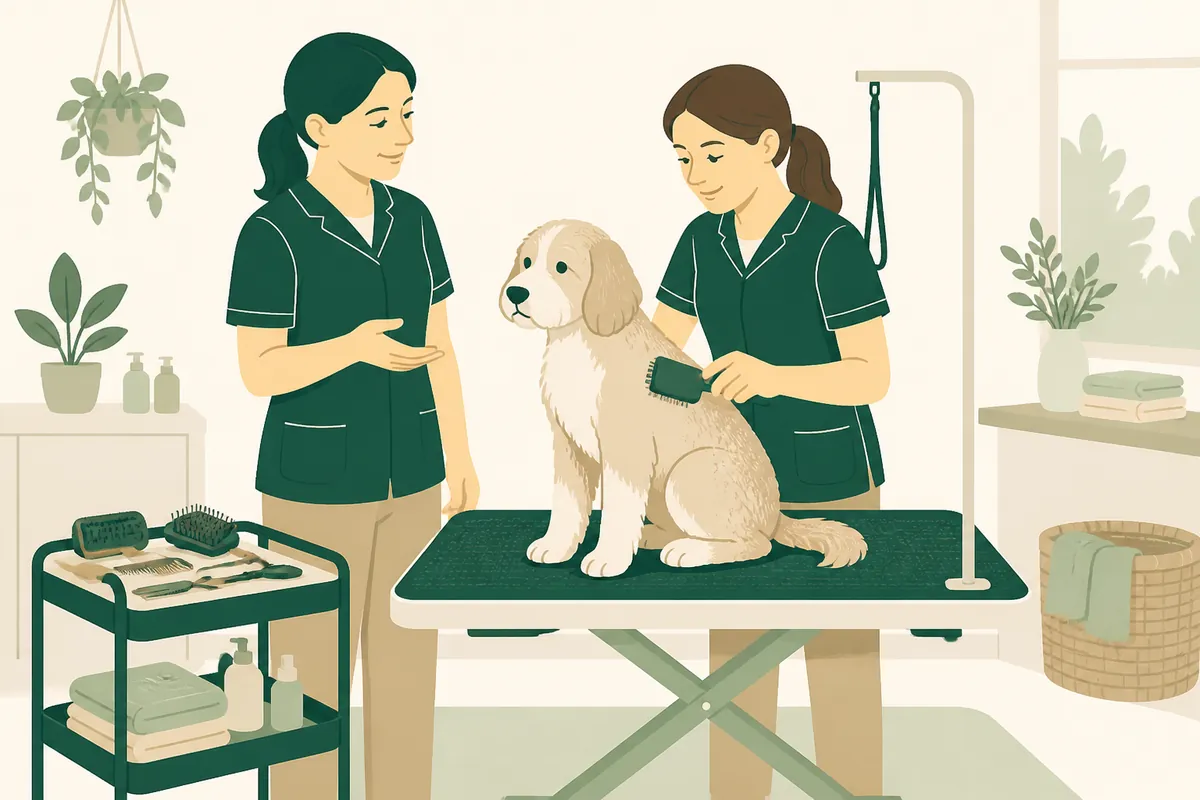
Only a person watching you work can assess those, which is why a practical examination exists as a separate thing in the trades that have one. If a provider implies that an online test demonstrates hands-on competence, it is overstating what it sells. The route most working groomers take, covered in our guide to becoming a certified dog groomer, combines the two deliberately.
Online, in person, or both
The three common routes do different jobs, and they are not really in competition:
| Route | What it builds | What it leaves out |
|---|---|---|
| Grooming school | Supervised hands-on practice on real dogs, quickly | Varies a lot in length and depth, and costs time away from earning |
| Salon apprenticeship or assistant role | Volume of real dogs, business exposure, often paid | Slow, and limited to the work that salon happens to do |
| Online certification | Structured knowledge, assessed and documented | Nothing hands-on, because nobody observes you |
We compare the first two in more detail in grooming school, apprenticeship or certification. In practice most people end up doing some of each, in whatever order their circumstances allow.
How to judge an online dog groomer certification
Before you pay, look for answers to these. A provider that cannot answer them is telling you something.
- Is the curriculum published? You should be able to see exactly which topics are assessed before you buy, not after.
- How is it marked, and against what? A number with no reference point means little. Marking against a stated curriculum means something.
- Does it tell you where you were weak? A result broken down by topic is useful. A bare pass or fail is not, because it gives you nothing to work on.
- Can anyone verify the certificate? A credential a client or an employer cannot check independently is worth roughly what a self-printed one is worth.
- Does it expire, and what does renewing involve? Either answer is fine. Not being told is not.
- How does it describe itself? This is the most revealing one. A provider that calls an online credential a license, or implies it grants a legal right to practice, has told you about its standards before you have even started.
PetCred belongs in that same frame. The Professional Dog Groomer assessment is twelve written, scenario-based questions in sixty minutes, marked against a published curriculum covering coat and skin, bathing and drying, de-matting, clipper and scissor theory, breed styles, handling, sanitation and recognizing health problems. You get a score by topic within minutes, three attempts are included, and a personalized course is built from whatever the score shows you are missing. Those who pass get a certificate with a public verification link. It does not observe hands-on skill and has no experience requirement, which is exactly the limit described above.
Does an online certification make you a licensed groomer?
No, and the distinction is worth getting right, because clients sometimes use the two words interchangeably.
A license is permission from a public authority to do something that would otherwise be prohibited. A certification is a statement by an organization that you met its standard. At the time of writing, grooming itself is generally not licensed in the four countries above, so there is usually no grooming license to hold in the first place.
What can apply is separate from any credential: a general business license, zoning or home-business rules if you work from home, permits if you board or run day care, trade waste and water rules for a salon, and vehicle requirements for mobile work. These are local and they change, so check with your local authority rather than relying on what is true somewhere else. Our article on whether you need a license to be a dog groomer goes through the four countries.
A certification answers "what does this person know?". A license answers "is this person permitted to trade?". No credential answers the second question for you.
Pairing an online certification with hands-on practice
The sequence that tends to work best is knowledge first, then supervised practice, because studying first makes practice time far more valuable. When you already understand why a double coat is dried the way it is, watching an experienced groomer do it teaches you technique, instead of teaching you both things at once.
A workable plan looks like this:
- Study and certify the knowledge online, at whatever pace your work allows.
- Arrange supervision: a bathing or assistant role in a salon, a short practical course, or an experienced groomer willing to watch you and correct you.
- Keep a log of the dogs you work on, recorded by coat type rather than by breed, so you can see which coats you have barely touched.
- Build a portfolio of photographs of your own finished work. For a client deciding whether to book you, that is the evidence sitting closest to the hands-on gap a certificate leaves open.
- Carry insurance from the first dog you groom for money, whatever your credentials say.
Next steps
If you are starting out, read the full route in how to become a certified dog groomer, then decide which of the three routes above fits the time and money you have this year.
If you want to see what a written grooming assessment is actually like before committing to anything, the free sample questions are the real format, and the Professional Dog Groomer program page lists the full curriculum so you can check it against what you already know.
Frequently asked questions
Can you become a certified dog groomer online?
You can certify the knowledge side online: coat and skin science, product and drying choices, handling decisions, safety and sanitation, and knowing when to refer a dog to a vet. You cannot certify scissor and clipper control through a screen, because nobody is watching your hands. Most groomers combine an online certification with supervised practice.
Is an online dog grooming certification worth it?
It depends on what you need it to do. It is good evidence that you understand the reasoning behind safe grooming, which matters to employers, insurers and careful owners. It is not evidence that you can execute a trim, so it works best alongside a practical course, an assistant role or a mentor who watches you work.
Does an online certification make you a licensed dog groomer?
No. Grooming is generally not a licensed profession in the US, UK, Canada and Australia at the time of writing, and no certification grants a legal right to practice. Any business permits, zoning rules or boarding licenses that apply come from your local authority and are separate from any credential.
Written by the PetCred Editorial Team and checked against the published curriculum for this program. Laws and requirements change and differ by place: check local rules before relying on anything legal or regulatory here.
Free course
Dog Grooming Fundamentals: A Free 5-Lesson Course
Five short lessons, a quick check after each, no sign-up. Start now →
More dog grooming guides
How to Become a Certified Dog Groomer: A Practical Guide
The skills a dog groomer needs, how to train through a school, apprenticeship or salon, which certification to choose and how to start working safely.
15 July 2026
Dog Groomer Certifications Compared: Which One Is Worth It?
The four kinds of dog grooming certification, what each one actually proves to an employer or a client, how to choose between them and the red flags to avoid.
11 November 2026
How to Trim Dog Nails Safely, Including Dark Nails
How to trim black dog nails and pale nails safely: finding the quick, choosing tools, a step-by-step method, what to do if you cut the quick and when to refer.
11 September 2026
How to Start a Mobile Dog Grooming Business
How to start a mobile dog grooming business: choosing a van or house calls, equipment, local rules and insurance, heat safety, pricing, routes and clients.
30 August 2026