Public Access Training: Standards and Assessment
Service dog public access training for trainers: the behaviors standards expect, how to build and proof them step by step, and how to judge team readiness.
PetCred Editorial Team · Updated 9 September 2026 · 6 min read
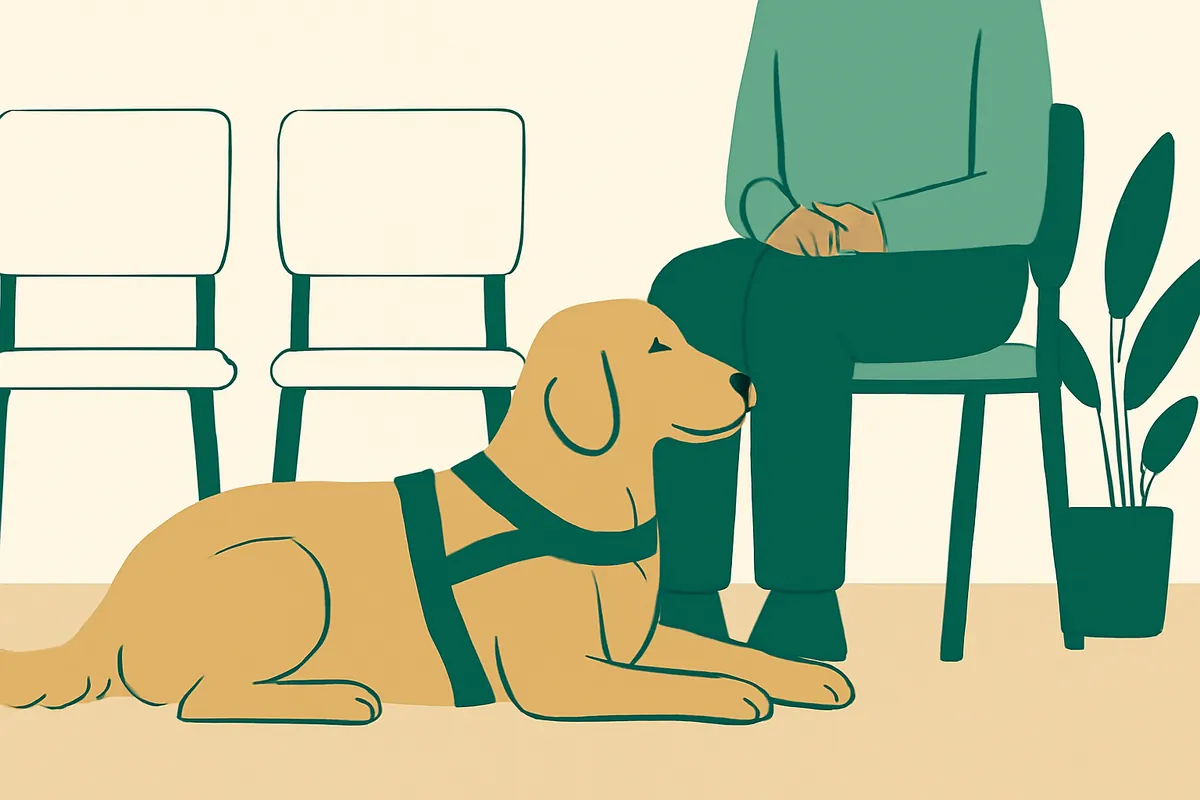
This article is for trainers who prepare service and assistance dogs to work in public places, whether in an organization or alongside owner-trainers. It explains what service dog public access training covers, the standards dogs are usually held to, how to build the skills in a sensible order and how to judge when a team is ready.
Public access training is separate from task training. Tasks are what the dog does for its handler. Public access behavior is how the dog conducts itself while it is out in the world: calm, clean, quiet and under control. A dog with brilliant tasks and poor public manners will struggle to work, and it damages the reputation of every other assistance dog team.
What public access training is for
In most places, the law that gives assistance dog teams access to shops and services also expects the dog to behave. In the US, for example, a business may ask for a service dog to be removed if it is out of control and the handler does not take effective action, or if it is not housebroken. In Australia, the federal definition of an assistance animal includes meeting hygiene and behavior standards appropriate for a public place. The details differ by country, so check the rules where you work, but the principle is the same everywhere: access comes with an expectation of good conduct.
Beyond the law, public access training protects:
- The dog, which should find public places manageable, not frightening.
- The handler, who needs to rely on the dog without constantly managing it.
- The public, including people who are afraid of dogs or allergic to them.
- Other teams, whose access depends on the trust that well-behaved dogs build.
The behaviors a public access standard expects
Different organizations write their standards differently, but they tend to expect the same behaviors. A dog ready for public work should:
- Walk on a loose lead beside the handler through crowds, doorways and narrow aisles, without pulling, lagging or weaving.
- Settle quietly under a table, beside a chair or at the handler's feet for as long as needed, and stay out of walkways.
- Ignore food: on the floor, on low shelves, on plates and when offered by strangers.
- Stay neutral around other dogs, without barking, lunging or trying to greet.
- Not solicit attention from staff or members of the public, and cope calmly when people try to touch it.
- Cope with the environment: automatic doors, elevators, shopping carts, wheelchairs, sudden noises and slippery floors.
- Toilet on cue before entering a building, and never inside unless it is ill.
- Load and travel calmly in cars, buses, trains or taxis, depending on the handler's life.
- Stay under control with the handler, including when the handler is seated, moving slowly or distracted.
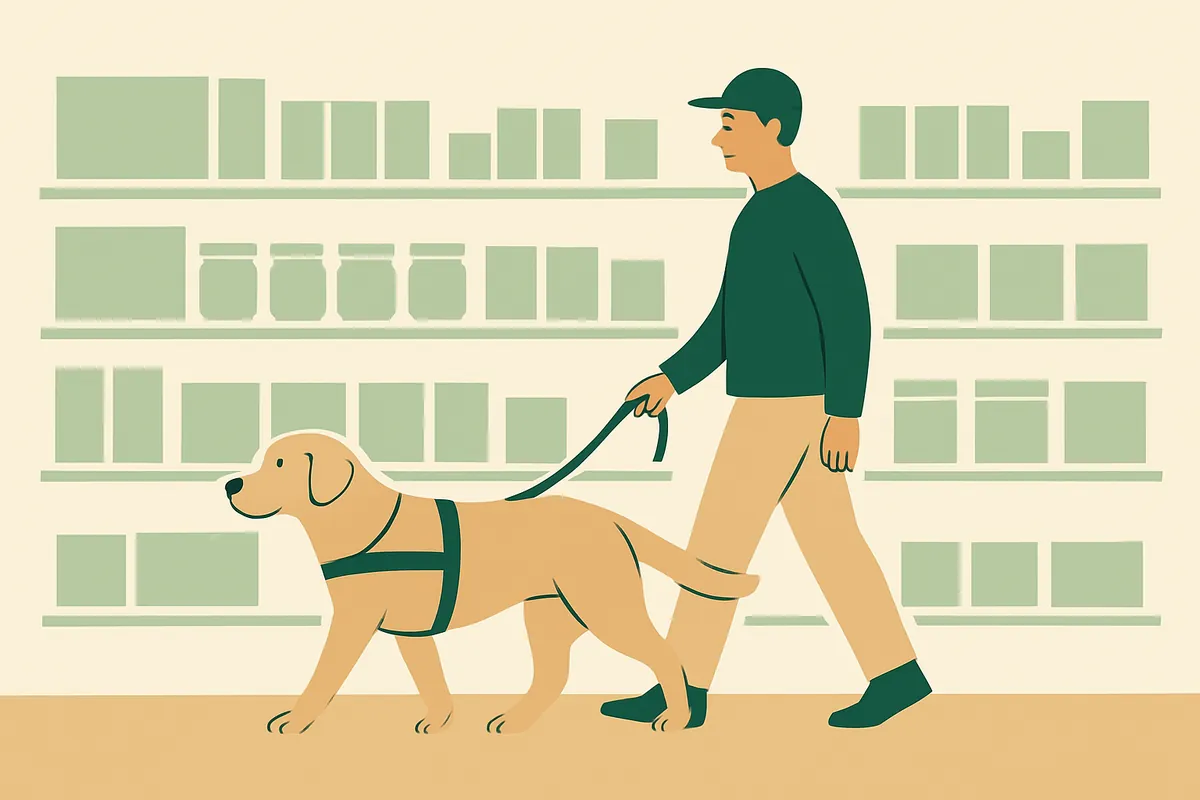
Public access standards and tests
There is no single public access test that applies everywhere, and in the US there is no government test at all. Instead you will meet a mix of standards:
- Assistance dog organizations set their own standards and assess their dogs and teams against them before placement and at intervals afterwards.
- Umbrella bodies publish standards for their members. Assistance Dogs International, for example, publishes a public access test and standards for its accredited member organizations.
- Government schemes in some places, such as certain Canadian provinces and Australian states, assess teams under their own rules.
- Foundation tests such as general good-manners assessments can be a useful early milestone, but they are not public access tests and do not show that a dog is ready to work in public.
If you work within an organization, you will use its standard. If you support owner-trainers, pick a published standard to train towards, explain which one you are using and why, and be clear that passing your own assessment does not give a dog any legal status.
Building public access skills step by step
Public access behavior is built gradually, from easy to hard, so the dog keeps succeeding. A typical progression looks like this:
- Foundations at home and in the training room. Loose-lead walking, a solid settle on a mat, leaving food, calm greetings and handling. These must be fluent before you go anywhere busy.
- Quiet outdoor places. Residential streets, parks at quiet times, empty parking areas. Practice the same behaviors with mild distractions.
- Dog-friendly indoor places. Pet stores, garden centers and other places where dogs are welcome, at quiet times first.
- Busier places, gradually. Increase crowds, noise and time spent inside. Keep early visits short and end them while the dog is still coping well.
- Places the handler will actually go. Supermarkets, offices, clinics, restaurants and public transport, following local rules on where dogs in training may go.
- Handing over to the handler. The dog must show the same behavior with its handler, not only with the trainer.
Where dogs in training are allowed is itself a legal question. In the US, the ADA does not cover dogs in training, though some states do. Elsewhere the position varies. Check before you take a dog into places where pets are not normally allowed, and ask permission when in doubt.
Proofing: distractions, duration and the handler
A behavior is proofed when it holds up under real conditions. Public work adds three kinds of difficulty, and each should be raised on its own before they are combined:
- Distraction. Food, people, other dogs, noise, movement. Add one at a time, starting mild.
- Duration. A two-minute settle is not a two-hour meeting. Build time gradually and give the dog breaks.
- The handler's state. Handlers may be tired, in pain, anxious or moving unpredictably. Practice with the handler seated, moving slowly, dropping things or giving cues less crisply than you would.
Watch the dog throughout. Lip licking, yawning, scanning, refusing food or a stiff body are signs that the difficulty is too high. Make the next step easier rather than pushing through, and if a dog keeps struggling in public, consider whether it is suited to the work at all.
Assessing readiness
Before a team works in public without a trainer present, they need an honest assessment. A practical approach:
- Use a written standard. Decide in advance which behaviors you are assessing and what counts as acceptable.
- Test in unfamiliar places. A dog that behaves in the store it has visited twenty times may not in a new one.
- Test the team, not the dog. The handler should handle, give cues and manage problems. Your job is to observe.
- Include realistic challenges: a dropped item, a friendly stranger, another dog at a distance, a meal-length settle.
- Record what you see, in plain descriptions, so the result can be explained and reviewed.
- Be willing to say "not yet". A delayed placement is better than a team that struggles in public.
Reassess regularly after placement too. Behavior drifts when a handler's life changes, when a dog ages or when small lapses are not corrected.
Common mistakes
- Going public too soon. Foundations that are shaky at home fall apart in a busy store.
- Raising several criteria at once. More distraction, more time and a new place all together is a recipe for failure.
- Training only with the trainer. A dog that is perfect for you and unreliable for its handler has not finished its training.
- Ignoring stress signals. A dog that is coping by shutting down may look well behaved while it is not.
- Treating gear as training. A vest does not create good public behavior, and it gives no legal rights by itself.
Next steps
Public access training sits within the wider career route in how to become a service dog trainer. It works best with dogs chosen for the job, as described in selecting a puppy or adult dog for assistance work, and it helps to be clear about the categories covered in service dog, therapy dog or emotional support animal.
To check your knowledge of public access standards, try the free sample service dog trainer questions, or see what the Therapy and Service Dog Trainer assessment covers.
Written by the PetCred Editorial Team and checked against the published curriculum for this program. Laws and requirements change and differ by place: check local rules before relying on anything legal or regulatory here.
Free course
Service and Therapy Dog Training Fundamentals: A Free 5-Lesson Course
Five short lessons, a quick check after each, no sign-up. Start now →
More service dog training guides
How to Become a Service Dog Trainer: A Practical Guide
What service dog trainers do, the skills and experience you need, how the law shapes the work and what a service dog trainer certification can and cannot show.
5 August 2026
Therapy Dog Programs: How Trainers Prepare Dogs and Handlers
How therapy dog programs work, the temperament and skills dogs need, how to coach handlers and what a good therapy dog trainer course or class should cover.
23 September 2026
Service Dog Laws for Trainers: US, UK, Canada and Australia
Service dog laws in the US, UK, Canada and Australia explained for trainers: who qualifies, what businesses may ask, dogs in training and what never to claim.
20 September 2026
Selecting a Puppy or Adult Dog for Assistance Work
What service dog temperament means in practice, how to assess puppies and adult dogs fairly, which health checks to ask for and when a dog is not suited.
28 August 2026