Service Dog Laws for Trainers: US, UK, Canada and Australia
Service dog laws in the US, UK, Canada and Australia explained for trainers: who qualifies, what businesses may ask, dogs in training and what never to claim.
PetCred Editorial Team · Updated 20 September 2026 · 7 min read
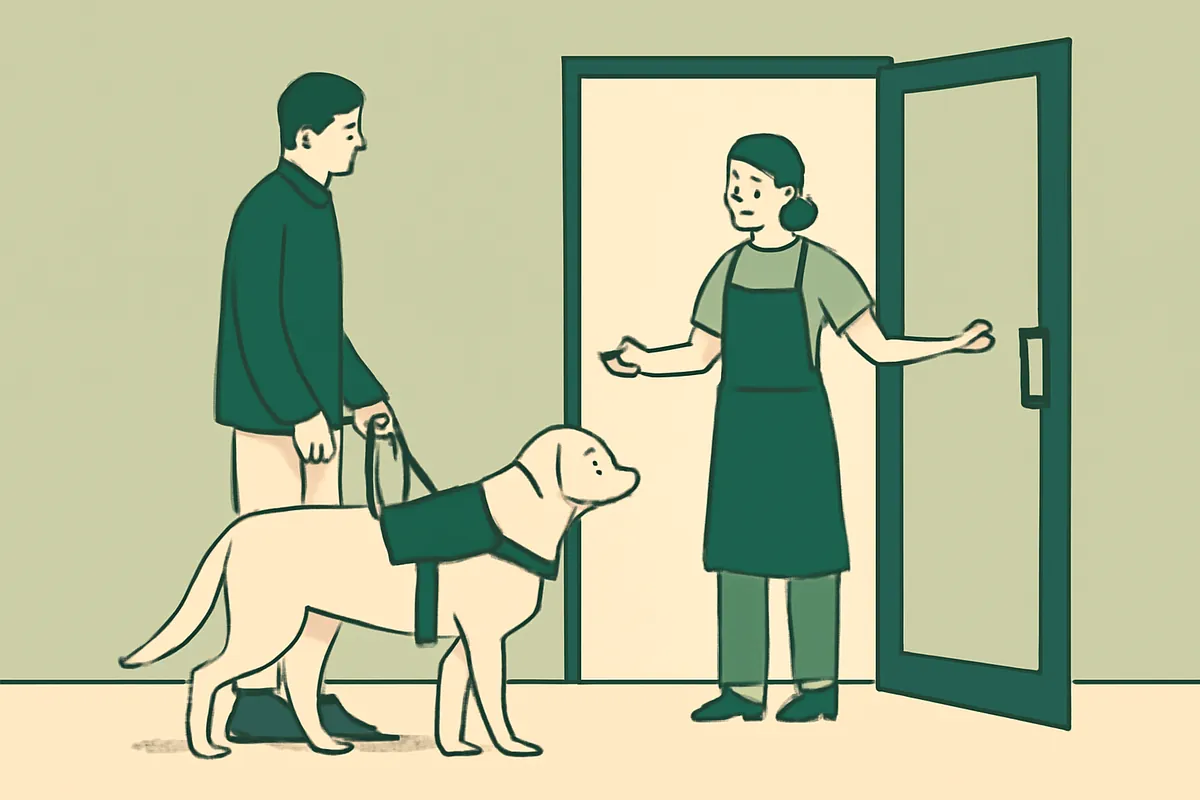
This article is written for dog trainers who work with service and assistance dogs, not for handlers or businesses. It summarizes the main service dog laws in the US, the UK, Canada and Australia at the time of writing, and focuses on the questions trainers are actually asked: who counts as a service dog, what businesses may ask, whether dogs in training have access and what trainers should never claim.
You do not need to be a lawyer to train assistance dogs, and you should not act like one. You do need to know the basics well enough to give accurate general information, to avoid misleading anyone, and to recognize when a client needs official guidance or legal advice.
This is general information, not legal advice. Laws change and differ between states, provinces and territories, and this summary simplifies them. Check the official guidance where you work, and refer clients with a specific dispute to a lawyer or a disability advocacy organization.
What service dog laws mean for trainers
In all four countries, access rights belong to a person with a disability and their assistance dog, not to the dog alone and not to the trainer. The laws are disability laws first: they exist to stop disabled people being excluded, and a dog's access follows from that.
Three consequences matter for your work:
- Your credentials do not give dogs rights. A trainer certificate, however good, does not make a dog a service dog.
- The dog's behavior matters. Access generally comes with an expectation that the dog is under control and clean in public.
- Dogs in training are usually treated differently from working dogs, and the rules vary more.
United States
The main federal law is the Americans with Disabilities Act (ADA), which covers state and local government services and businesses open to the public.
- A service animal is a dog individually trained to do work or perform tasks for a person with a disability. The ADA also has a separate, limited provision for miniature horses.
- Emotional support, comfort and therapy animals are not service animals under the ADA.
- No certification, registration or professional training is required. Handlers may train their own dogs.
- When it is not obvious what the dog does, staff may ask only two questions: whether the dog is required because of a disability, and what work or task it has been trained to perform. They may not require documentation, ask for a demonstration or ask about the disability.
- A business may ask for the dog to be removed if it is out of control and the handler does not take effective action, or if it is not housebroken.
- The dog should be harnessed, leashed or tethered unless that interferes with its work or the handler's disability prevents it, in which case the handler must keep control by voice or signals.
- Businesses may not charge extra fees for a service animal, although a handler can be charged for damage if other customers would be.

Other federal laws apply in other settings:
- Housing. Under the Fair Housing Act, assistance animals, which can include emotional support animals, may be a reasonable accommodation for a person with a disability. Housing providers can ask for reliable documentation when the disability or need is not obvious, and federal guidance has cautioned that certificates sold online are not, on their own, reliable documentation.
- Air travel. Since early 2021, US airlines have not been required to treat emotional support animals as service animals, and they may ask service dog handlers to complete Department of Transportation forms.
- Employment falls under a separate part of the ADA, where an employee may request a service animal as a reasonable accommodation.
State laws add to this. Many states have their own service animal laws, some cover dogs in training, and a number make it an offense to misrepresent a pet as a service animal.
United Kingdom
In England, Scotland and Wales, the main law is the Equality Act 2010. Northern Ireland has its own disability discrimination law.
- Service providers, employers and landlords must make reasonable adjustments for disabled people. For assistance dog users, that usually means allowing the dog.
- Taxi and private hire drivers must carry assistance dogs at no extra charge unless they have a medical exemption. The taxi rules use their own definition of an assistance dog, so check current guidance on how they apply to a particular dog.
- There is no official register of assistance dogs and no legally required identification. Many assistance dogs are trained by charities that belong to Assistance Dogs UK, and those dogs carry identification from their charity.
- Emotional support animals have no specific legal status.
- Dogs in training have no specific legal right of access, though businesses may choose to allow them.
Because access rests on reasonable adjustments rather than a detailed definition, disputes are decided on their facts. That makes accurate, calm information from trainers especially valuable.
Canada
Canada has federal and provincial layers, and the rules depend on where the team is and who runs the service.
- Human rights laws at the federal and provincial level protect people with disabilities, including those who use service dogs.
- Some provinces have their own service dog laws. British Columbia and Alberta, for example, have legislation with government certification or identification for qualifying dog and handler teams, and British Columbia's law also penalizes falsely claiming that a dog is certified. Check the current rules in each province where you work.
- Ontario's accessibility rules for customer service address service animals, including how a service animal can be identified.
- Air travel falls under federal accessibility rules, which deal with service dogs. How airlines treat emotional support animals is largely up to the carrier.
If you train in Canada, find out whether your province has a certification scheme and what it requires, because it affects what your clients can expect.
Australia
The federal law is the Disability Discrimination Act 1992. It defines an assistance animal as a dog or other animal that is:
- accredited under a state or territory law to assist a person with a disability, or
- accredited by an animal training organization prescribed by the regulations, or
- trained to assist a person with a disability to alleviate the effect of the disability, and meets standards of hygiene and behavior appropriate for an animal in a public place.
A person with an assistance animal can be asked to produce evidence that the animal is an assistance animal and is trained to meet those hygiene and behavior standards.
States and territories add their own laws. Queensland, for example, runs a certification scheme for guide, hearing and assistance dogs under its own legislation. Rules on public transport and companion animals also differ between states. An animal that provides comfort but is not trained to alleviate the effects of a disability does not fit the federal definition.
Credentials, vests and ID
Trainers are often asked to supply vests, ID cards or certificates. Keep to three rules:
- Do not sell or recommend online registrations as official. None of them creates legal status in any of the four countries.
- Separate gear from status. A vest helps the public recognize a working dog; it does not prove or create rights.
- Describe your own credentials accurately. Say exactly what you hold and who issued it, and never imply that it certifies dogs or grants access.
Dogs in training
This is the question trainers ask most, and the answer varies more than any other:
- In the US, the ADA does not cover dogs in training. Some states give access rights to dogs in training, sometimes only to trainers from recognized programs.
- In the UK, there is no specific right of access for dogs in training.
- In Canada and Australia, it depends on the province or state. Some schemes recognize approved trainers or dogs in training; others do not.
Where there is no right of access, ask permission, explain what you are doing and accept a refusal gracefully. Good relationships with local businesses help every team.
A checklist for advising clients
When a client asks a legal question:
- Find out which country, state or province, and which setting: a shop, housing, work, a flight.
- Share general information you are confident of, and say that it is general.
- Point them to the official guidance for their jurisdiction.
- For a specific dispute, suggest a lawyer or a disability advocacy organization.
- Keep a note of what you told them.
Next steps
For the categories behind these laws, see service dog, therapy dog or emotional support animal. The behavior standards the laws expect are covered in public access training: standards and assessment, and the whole career route is in how to become a service dog trainer.
To test your understanding of the legal frameworks, try the free sample service dog trainer questions, or see what the Therapy and Service Dog Trainer assessment covers.
Frequently asked questions
Is there an official service dog registry?
Not in the US, where the ADA requires no registration or certification. The UK has no official register either. Some Canadian provinces and Australian states run government certification schemes, but websites that sell registrations to anyone do not create legal status anywhere.
Do service dogs in training have public access rights?
It depends on where you are. The ADA does not cover dogs in training, though some US states do, and the UK has no specific right of access for them. In Canada and Australia it depends on the province or state. Where there is no right, ask permission.
Can a trainer certify a dog as a service dog?
Not in a way that creates legal rights, except where a government scheme recognizes that trainer or program. A trainer can assess a team against a published standard and describe the result honestly, but should never imply that their assessment grants access.
Written by the PetCred Editorial Team and checked against the published curriculum for this program. Laws and requirements change and differ by place: check local rules before relying on anything legal or regulatory here.
Free course
Service and Therapy Dog Training Fundamentals: A Free 5-Lesson Course
Five short lessons, a quick check after each, no sign-up. Start now →
More service dog training guides
How to Become a Service Dog Trainer: A Practical Guide
What service dog trainers do, the skills and experience you need, how the law shapes the work and what a service dog trainer certification can and cannot show.
5 August 2026
Therapy Dog Programs: How Trainers Prepare Dogs and Handlers
How therapy dog programs work, the temperament and skills dogs need, how to coach handlers and what a good therapy dog trainer course or class should cover.
23 September 2026
Public Access Training: Standards and Assessment
Service dog public access training for trainers: the behaviors standards expect, how to build and proof them step by step, and how to judge team readiness.
9 September 2026

Selecting a Puppy or Adult Dog for Assistance Work
What service dog temperament means in practice, how to assess puppies and adult dogs fairly, which health checks to ask for and when a dog is not suited.
28 August 2026