Insurance and Contracts for Dog Trainers
Dog trainer insurance explained: liability, professional indemnity and animal care cover, what a training contract should include, and the limits of waivers.
PetCred Editorial Team · Updated 29 August 2026 · 7 min read

Most dog trainers never need to make a claim, but the ones who do are rarely careless. A dog slips its leash in class and knocks over a passer-by, a client's dog bites your assistant, an owner says your advice made their dog worse. Dog trainer insurance and a clear written contract are what stand between an incident like that and the end of your business.
This article explains the main kinds of insurance trainers carry, what a good training contract covers, and how the two work together. It is general guidance, not legal or insurance advice: rules and policies differ between countries, states and insurers, so check the details with a broker, an insurer or a lawyer where you work.
Do dog trainers need insurance?
In most places there is no law that says a dog trainer must carry insurance to work, just as there is usually no license to train dogs. In practice, most professional trainers are insured, for three reasons:
- Incidents happen even to careful trainers. You work with animals whose behavior you cannot fully control, often in public places and in other people's homes.
- Partners ask for it. Many venues, community halls, rescues, vets and employers will not work with an uninsured trainer, and some ask to see your certificate of insurance.
- Clients look for it. Being able to say you are insured is part of looking like a professional.
The picture changes once you employ people. In the UK, employers' liability insurance is generally a legal requirement for businesses with employees, and in the US most states require workers' compensation coverage for employees. Canada and Australia have their own workers' compensation schemes. The details, including who counts as an employee, vary, so check with your local authority or a broker before you take anyone on. Our guide to whether you need a certification to be a dog trainer covers the wider legal picture.
The main types of insurance for dog trainers
Policy names differ between countries and insurers. Many insurers offer packages designed for animal professionals that combine several of these.
| Type of cover | What it is generally for |
|---|---|
| Public liability (UK, Australia) or general liability (US, Canada) | Injury to other people or damage to their property caused by your business, such as a dog in your class knocking someone over |
| Professional indemnity, also called errors and omissions | Claims that your advice or service was negligent and caused a loss, such as an owner saying your training plan made a problem worse |
| Care, custody and control | Injury to, loss of or illness in animals while they are in your care, for example during board-and-train or day training |
| Employers' liability or workers' compensation | Injury or illness to people who work for you |
| Equipment and business property | Theft of or damage to your training equipment, laptop and phone |
| Business vehicle cover | Using your car for work and transporting dogs, which a personal car policy may not cover |
Questions to ask before you buy
- Does the policy cover all the services you offer? Private sessions, group classes, board and train, day training, dog walking and behavior work can each be treated differently.
- Does it cover work in clients' homes, in public places and at hired venues?
- Are there exclusions for certain breeds, dogs with a bite history or specific kinds of behavior work?
- Does it cover assistants and volunteers, or only you?
- What are the limits and the excess (the amount you pay yourself on each claim)?
- Does the insurer ask about your qualifications or memberships, and does holding them change the terms?
- What must you do after an incident, and how quickly must you report it?
Read the policy wording, not just the summary. If a service you offer is not clearly covered, ask the insurer to confirm in writing.
Why you need a written contract
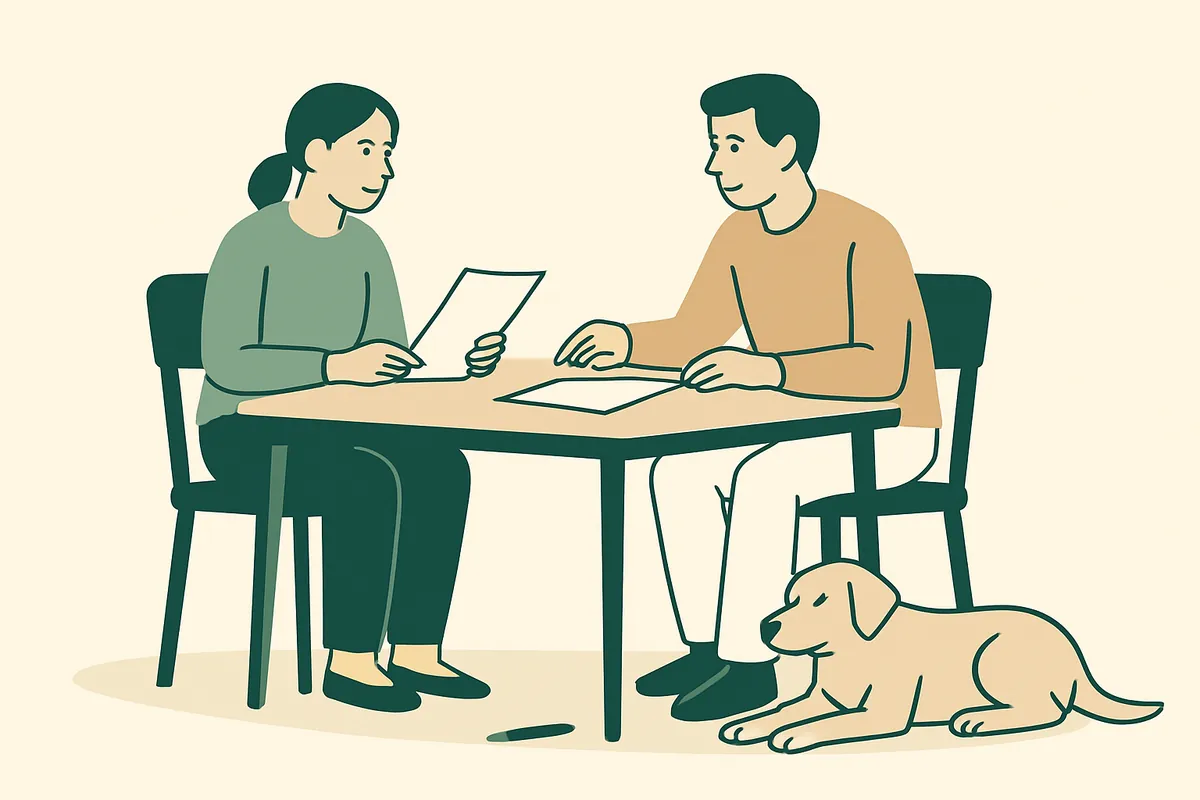
Insurance pays out after something goes wrong. A contract helps prevent problems in the first place, by making sure you and the owner agree on what you will do, what they will do and what happens when plans change. It also gives you a record if there is ever a dispute.
Most trainers use a service agreement that clients sign before the first session, on paper or online. For group classes it is often a shorter enrollment form with the same key points.
What a dog training contract should cover
- The parties and the dog. Your business name and contact details, the owner's details and the dog's name, age, breed and description.
- The service. What is included: number and length of sessions, where they take place, any written plans or support between sessions, and what is not included.
- Your methods. A short statement of how you train, for example that you use reward-based methods, so owners know what to expect.
- No guarantee of results. Behavior depends on the dog, the owner's practice at home and many things outside your control. State that you will provide a plan and support, not a guaranteed outcome. Many professional codes of practice forbid guarantees.
- The owner's responsibilities. Practicing between sessions, following management advice, keeping the dog under control and, where it applies, keeping vaccinations and parasite treatments up to date as their vet advises.
- Health and behavior disclosure. The owner confirms they have told you about any health problems, medication, bite history or aggression. This matters for your safety, for other clients and for your insurance.
- Referral. You may recommend a vet visit or refer the case to a behavior professional if you think a problem has a medical cause or is beyond the scope of training. Sudden behavior changes in particular should be checked by a vet.
- Fees and payment. How and when payment is due, and what happens with unpaid invoices. Keep specific prices on a separate price list, so the contract does not need updating every time prices change.
- Cancellations and rescheduling. Notice periods, what happens to a session the client misses, and what happens if you have to cancel.
- Photos and video. Whether you may film sessions for training feedback and whether you may use images in your marketing. Make these separate choices the client can say yes or no to.
- Data protection. How you store and use the client's personal information. Data protection laws apply to small businesses too, and the rules vary by country.
- Incidents. How incidents will be reported and recorded.
- Ending the agreement. How either side can end it, and what happens to any payment for sessions not yet used.
A note on waivers
Many trainers include a clause in which the owner accepts the risks of training and agrees not to hold the trainer responsible for certain outcomes. These clauses can be useful for setting expectations, but they have limits. In many places, a clause cannot protect you from liability for your own negligence, and consumer protection law may restrict what you can exclude. A waiver is never a substitute for insurance or for working safely. This is one of the most important reasons to have a lawyer look over your contract.
Keeping records
Good records support both your insurance and your contract:
- Keep signed agreements and intake forms for as long as your insurer or lawyer advises.
- Write short notes after each session: what you did, what you advised and anything that concerned you.
- Record any incident on the day, with the date, time, who was present, what happened and what you did. Tell your insurer as the policy requires, even if you think no claim will follow.
- Keep copies of any referral you made to a vet or a behavior professional.
Notes written at the time are far more convincing than memories reconstructed months later.
Common mistakes
- Assuming a home or car policy covers business activity. It often does not.
- Offering a new service without checking your policy. Board and train, dog walking and behavior work are frequent gaps.
- Using a contract copied from the internet without checking that it fits your services and your local law.
- Promising results in marketing that your contract says you cannot guarantee.
- Skipping the intake form for a "quick" session. The quick sessions are where surprises happen.
Next steps
Insurance and contracts are part of setting up properly, alongside a clear offer and fair prices. Our guide to getting your first dog training clients covers the rest of the business side, and how to become a certified dog trainer walks through the whole route into the profession. If you run group classes, see how to run a puppy class for setting up a safe room.
Some insurers ask about qualifications when pricing a policy, and clients look for them too. The Professional Dog Trainer certification assesses the knowledge behind safe, reward-based training, and you can try the free sample dog trainer questions to see how it works.
Frequently asked questions
What insurance does a dog trainer need?
Most trainers carry public or general liability insurance, and many add professional indemnity and cover for animals in their care. If you employ staff, employers' liability or workers' compensation cover may be a legal requirement. The right mix depends on your services, so check with a broker.
Does a waiver protect a dog trainer from being sued?
Not fully. A waiver can set expectations and record that the owner understood the risks, but in many places it cannot exclude liability for your own negligence. It works alongside insurance and safe practice, never instead of them, and a lawyer should check the wording.
Written by the PetCred Editorial Team and checked against the published curriculum for this program. Laws and requirements change and differ by place: check local rules before relying on anything legal or regulatory here.
Free course
Dog Training Fundamentals: A Free 5-Lesson Course
Five short lessons, a quick check after each, no sign-up. Start now →
More dog training guides
How to Become a Certified Dog Trainer: A Practical Guide
What a dog trainer actually needs to know, how to get hands-on experience, which certification to choose and how to find your first clients, step by step.
6 July 2026
How to Price Your Dog Training Services
How to set dog trainer prices without guessing: work out your costs and real hours, research your local market, price the value and choose service formats.
10 September 2026

Loose-Leash Walking: A Trainer's Step-by-Step Plan
A loose leash walking training plan for trainers: why dogs pull, equipment, eight stages from indoors to busy streets, troubleshooting and coaching owners.
17 August 2026
How to Run a Puppy Class
A puppy training class plan for trainers: who the class is for, how to set up the room, a six-week outline, session structure and handling shy puppies.
6 August 2026