What a Dog Trainer Certification Exam Asks, With Sample Questions
The topics dog trainer exams test, the difference between multiple choice and written assessments, and three sample questions with model answers.
PetCred Editorial Team · Updated 24 September 2026 · 5 min read

Whichever dog trainer certification you choose, its exam will test much the same body of knowledge. What differs is the format: some exams ask you to pick an option, some ask you to explain your reasoning in writing, and some ask you to show your training on video.
This article covers the topics exams test, how the main formats differ and how to prepare, then works through three sample questions with model answers.
What dog trainer exams test
Most exams cover these areas, in varying depth:
- Learning theory: classical and operant conditioning, reinforcement and punishment, markers and timing, reinforcement schedules. See positive reinforcement dog training, explained.
- Building behaviors: luring, capturing and shaping; adding cues; fluency, generalization and proofing.
- Body language and stress: early stress signals, arousal, play versus conflict, when a dog cannot learn.
- Development: puppy socialization, adolescence and the needs of older dogs.
- Everyday problems: pulling, jumping up, recall, barking, mouthing, house training.
- Equipment and management: harnesses, leads, gates and crates, and humane tool choices.
- Teaching people: coaching owners, running group classes and session planning.
- Ethics and scope: when to refer to a vet or behavior specialist, and honest claims.
The three formats
| Format | What you do | What it shows | Watch out for |
|---|---|---|---|
| Multiple choice | Pick one option from several | Recognition of correct facts | Can be passed by elimination without deep understanding |
| Written scenarios | Explain what you would do and why | Reasoning and applied knowledge | Vague or padded answers score poorly; substance counts |
| Practical or video | Show training on real dogs | Handling skill and timing | Needs equipment, preparation and suitable dogs |
The PetCred Professional Dog Trainer assessment uses written scenarios: 12 questions in 60 minutes, marked against a published curriculum, with a score by topic.
How to prepare
- Study the topic list, not just the parts you enjoy. Most people over-prepare learning theory and under-prepare equipment, classes and client coaching.
- Practise explaining. Say out loud, or write, why you would do something. If you can only say "it works", keep studying.
- Use real cases. For each topic, think of a dog you have worked with and how the theory applied.
- Review stress signals from video. Watch clips with the sound off and describe exactly what you see before interpreting it.
- Time yourself. In written exams, a short complete answer beats a long unfinished one.
Sample question 1: a recall that fails in the park
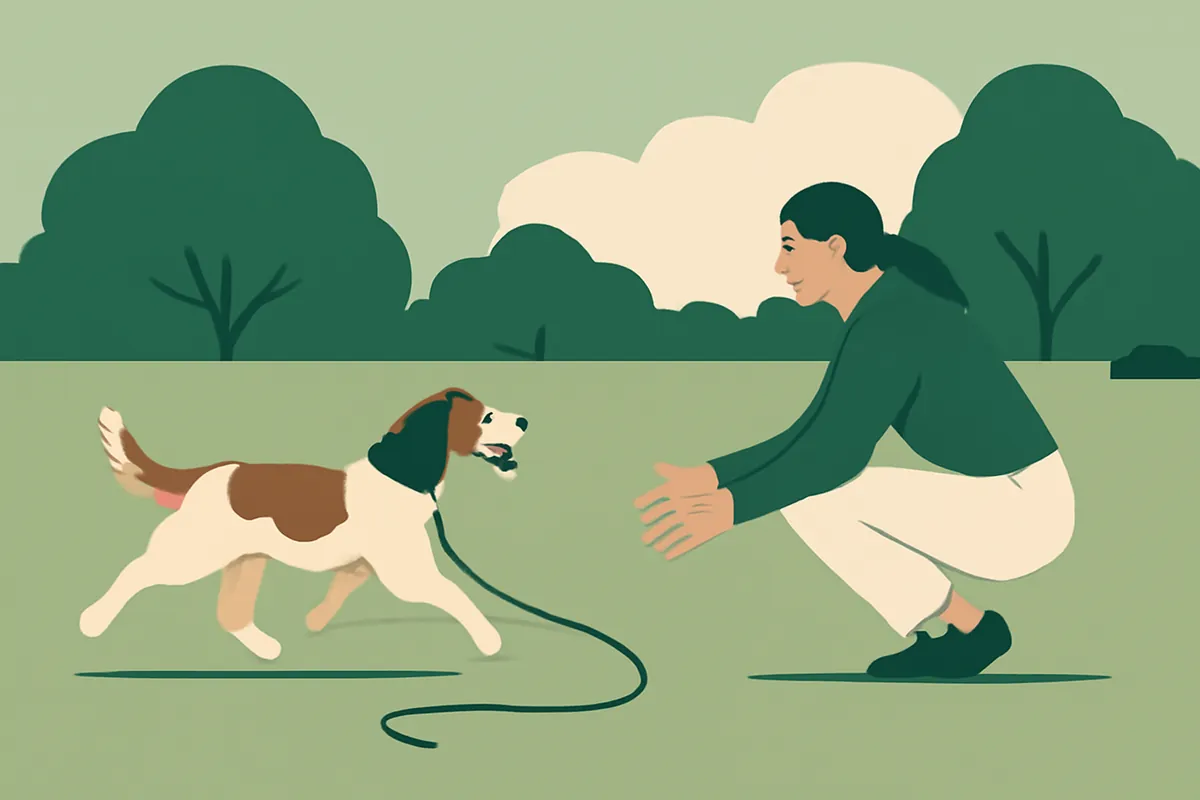
Question. A client's 10-month-old spaniel comes back reliably in the garden but ignores the recall completely in the park. The owner has started shouting, then putting the dog on the lead as soon as it finally returns. Explain what is going on and what you change.
What a strong answer covers:
- Why it fails: the recall was only trained in one quiet place, so it has not generalized. In the park it competes with far stronger rewards such as scent, other dogs and movement, and at ten months the dog's interest in the environment is at its peak.
- What the owner has taught: that coming back ends the fun and sometimes earns a telling-off. Shouting makes the cue itself unpleasant, and clipping the lead on every time makes coming back predict the end of freedom. The cue is becoming poisoned.
- The plan: stop using the old cue in the park and use a long line so the dog cannot rehearse ignoring it. Teach a new cue at short distances in quiet places, reward with something the dog truly values, and release it back to play most of the time. Raise distractions gradually and only call when success is very likely. The owner's homework is several easy recalls on every walk, and never calling the dog for something it dislikes.
Sample question 2: early stress signals in class
Question. Name four early signs that a dog in your class is becoming stressed, before any growling or lunging, and say what you would do when you see them.
Model answer:
- Lip licking or tongue flicks with no food present.
- Yawning out of context, often repeated.
- Whale eye: the head turned away while the eyes follow the trigger, showing the whites.
- Refusing food it took happily a minute earlier.
Reasoning: these appear well before warning behaviors and are easy to miss in a busy room. Refusing food is especially telling in class, because a dog that cannot eat is over its threshold and cannot learn. The response is to change the environment, not the dog: add distance from the other dogs, use a visual barrier, make the task easier or take a short break outside. Asking the owner to push through would teach the dog that its quiet signals do not work.
Sample question 3: building a reliable cue
Question. You are teaching a reliable "down" from scratch. Put these steps in order and explain the order: build duration and distance; add the verbal cue; get the behavior happening reliably and reward it; practise in new places; fade the lure to a hand signal; move to rewarding some responses rather than every one.
Model order:
- Get the behavior happening reliably, by luring or capturing, and mark and reward it.
- Fade the lure to a hand signal.
- Add the verbal cue just before the dog lies down.
- Build duration and distance, one at a time.
- Practise in new places, starting at an easier level in each.
- Move to rewarding some responses rather than every one.
Reasoning: the behavior comes before its name, or the word becomes attached to confusion. The lure goes early so food in the hand does not become part of the cue. Duration and distance are raised separately, because raising two criteria at once is a common reason dogs fail. New places come before thinning rewards: when the environment gets harder, the pay should stay generous, and only a behavior that is fluent everywhere can survive a leaner schedule.
Try them yourself
Reading model answers is useful; writing your own first is better. The free sample dog trainer questions let you type your answers, reorder steps and then reveal the model answer. No account is needed.
For the wider picture, see how to become a certified dog trainer and dog trainer certifications compared.
Written by the PetCred Editorial Team and checked against the published curriculum for this program. Laws and requirements change and differ by place: check local rules before relying on anything legal or regulatory here.
More dog training guides
How to Become a Certified Dog Trainer: A Practical Guide
What a dog trainer actually needs to know, how to get hands-on experience, which certification to choose and how to find your first clients, step by step.
24 September 2026

Do You Need a Certification to Be a Dog Trainer? Rules in the US, UK, Canada and Australia
Dog training is largely unregulated, but that is not the whole story. What the law requires in four countries, what clients expect and when certification matters.
24 September 2026

Dog Trainer Certifications Compared: Exams, Courses and What Each One Proves
Exam-based credentials, academy programs, association membership and online assessments: how the main kinds of dog trainer certification differ and how to choose.
24 September 2026
Positive Reinforcement Dog Training, Explained for New Trainers
The learning science every dog trainer needs: reinforcement and punishment, markers, timing, reinforcement schedules and why reward-based training is the modern standard.
24 September 2026