Starting Puppies in Agility Safely
What young dogs can safely learn in agility, what waits until they are physically mature, how to run a puppy class and when to send a young dog to its vet.
PetCred Editorial Team · Updated 20 August 2026 · 6 min read
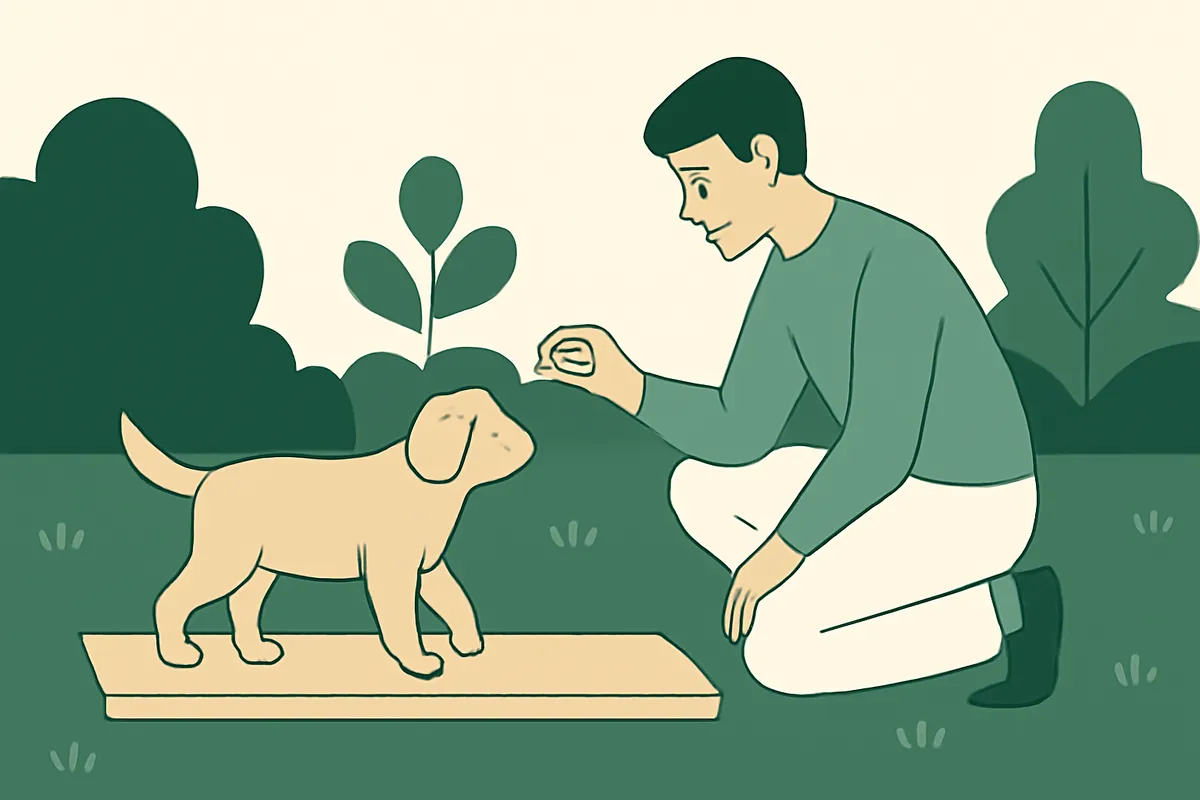
Starting puppies in agility safely means teaching the skills of the sport long before the dog meets full-height equipment. A young dog can learn a great deal in its first year: focus, body awareness, confidence on moving surfaces, the start of handling cues and a love of the game. What it should not do is repeated jumping at height, full-size weave poles or high contact obstacles while its bones and joints are still developing.
This guide is for agility instructors and trainers who run puppy and foundation classes, and for experienced handlers starting a new dog. It covers why young dogs need a different program, what to teach and what to hold back, how to structure a puppy session, and when to involve the dog's vet.
This article gives general guidance. When a young dog is ready for each stage depends on the individual dog, and its vet is the right person to advise on that.
Why young dogs need a different program
Puppies grow from areas of soft, developing tissue near the ends of their long bones, often called growth plates. Until those areas mature and close, they are more vulnerable to injury from repeated impact, twisting and landing with force, which is exactly what full agility asks of a dog. When they close varies by size and breed: small dogs tend to mature earlier and large and giant breeds later, often well into their second year.
Muscles, tendons and coordination also take time to develop. A young dog is often more enthusiastic than it is coordinated, which is part of what makes puppy agility fun and part of what makes it risky.
That is why governing bodies set minimum ages for competition, and why responsible instructors set their own entry ages for classes that use full equipment. Check the current rules of the organization your students compete with. For individual dogs, the dog's vet can advise, sometimes with an examination or X-rays, on whether it is physically mature enough for more demanding work.
What puppies can safely learn
Most of what makes an agility dog successful can be taught at ground level. A good foundation program covers:
- Focus and engagement. Playing with the handler, switching between food and toys, and choosing to stay with the handler around distractions.
- Body awareness. Knowing where its back feet are, stepping over low poles on the ground, backing up, turning in both directions and standing on a low platform.
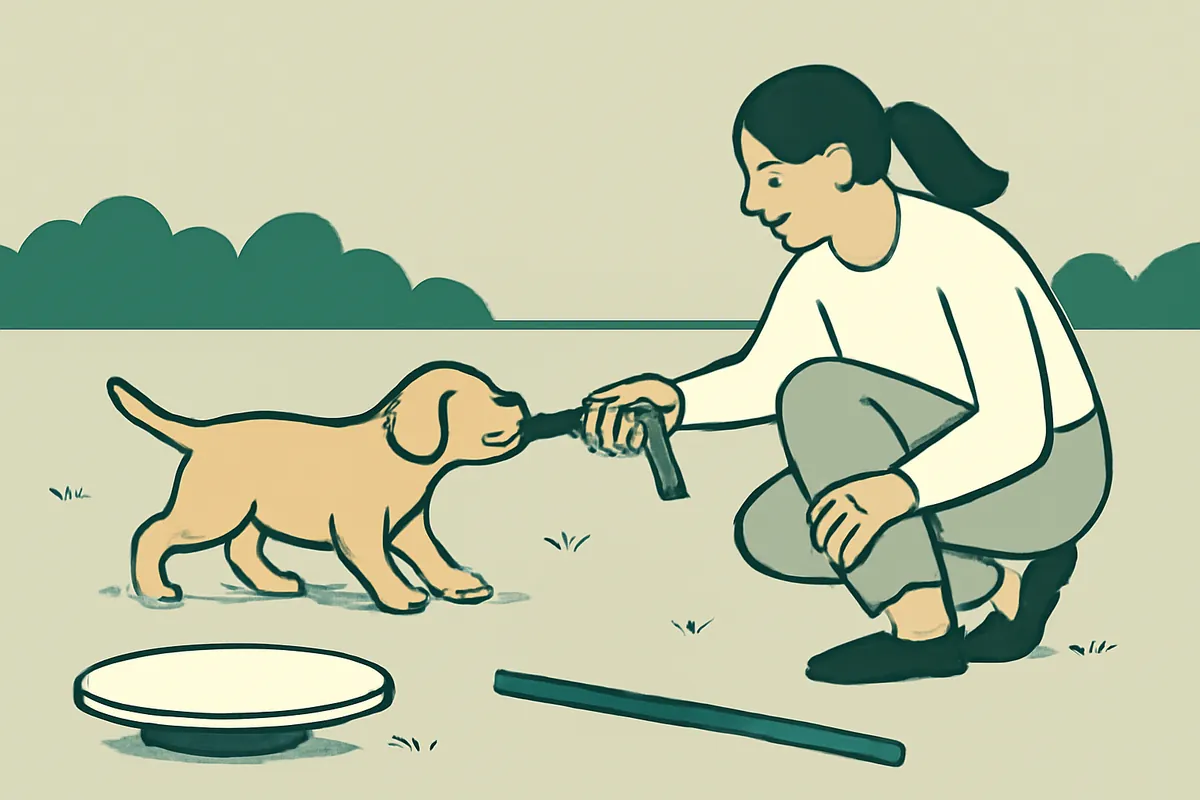
- Confidence with movement and noise. Low, stable surfaces that move slightly, such as a wobble board sitting very close to the ground, introduce the feeling of the seesaw without height or a board that drops.
- Tunnels. A short, straight, secured tunnel at full width is usually fine for a young dog, as long as it is held firmly in place.
- Handling foundations. Following the handler's shoulders and hands on flat ground, driving ahead to a target, and responding to a turn cue.
- Start-line and stay behaviors. Waiting until released, which pays off for the rest of the dog's career.
- Targets. A nose or paw target that later becomes part of contact behaviors.
What to hold back until the dog is physically mature
- Jumping at height. Bars on the ground or at a very low height teach the idea of going between wings. Repeated jumping at competition height waits.
- Full weave poles. Weaving bends the spine repeatedly at speed. Foundation methods that use open or guided poles can come later; full, closed weaves come last.
- The full A-frame, dog walk and seesaw at height. Contact behaviors can be taught on a low plank or a board on the ground. Height and the full seesaw drop come once the dog is mature and confident.
- Tight turns at speed and long sequences. Short, simple and flowing is the rule.
- Repetitive drilling. Young dogs tire quickly, and a tired dog is a clumsy one.
Structuring a puppy class
Puppy and foundation classes work best when they are short, varied and generous with rest.
| Part | What happens | Why |
|---|---|---|
| Arrival | Puppies settle on mats or in crates at a distance from each other | Calm before work, no free-for-all greetings |
| Warm-up | Gentle movement and play with the handler | Prepare the body, build engagement |
| Skill blocks | Two or three short exercises, one or two minutes each per puppy | Short turns suit short attention spans |
| Rest | Puppies rest while others work | Prevents fatigue and overexcitement |
| Handler coaching | Explain the homework for the week | Most progress happens at home |
Keep groups small, so you can watch every puppy. Keep the surface soft and non-slip. Keep puppies of very different sizes working apart from each other, and do not allow off-lead play between puppies in an agility class, where the aim is focus on the handler.
Signs a puppy needs a break, or a vet
Watch every puppy for these signs, and stop the exercise when you see them:
- Slowing down, lying down, sniffing the ground or wandering away.
- Stumbling, clumsiness that is new for that puppy, or crashing into equipment.
- Heavy panting that does not settle with rest, especially on warm days.
Some signs are not about tiredness and need the dog's vet rather than a rest:
- Limping, even briefly, or favoring a leg after rest.
- Stiffness when getting up, reluctance to jump onto the sofa or into the car, or yelping when touched.
- Any swelling of a joint.
Your role is to notice and refer, not to diagnose. Tell the handler what you saw, suggest they have the puppy checked, and do not let it return to jumping or contact work until its vet is happy.
Common mistakes in puppy agility
- Letting enthusiasm set the pace. A young dog that loves the game will keep going far past the point where it is safe. The instructor has to be the one who stops.
- Treating size as maturity. A tall, gangly adolescent may look like an adult and be nowhere near one.
- Home equipment set too high. Handlers often buy equipment and practice at home. Tell them which heights and obstacles are appropriate now, in writing.
- Skipping foundations to get to the fun part. Dogs that go straight to full equipment often have to relearn contacts or weaves later, when bad habits are harder to change.
- Forgetting the handler. Puppy classes are the best time to teach handlers timing, reward placement and how to read their own dog.
Moving a young dog on
When a dog is physically mature, as judged by the dog's vet and its breed and size, it can move on in steps:
- Raise jump heights gradually, over weeks rather than in one session.
- Build weave poles from an open or guided method toward full poles.
- Introduce contact obstacles at low height, then raise them, with the full seesaw drop last.
- Lengthen sequences only once each part is confident and fluent.
- Keep up conditioning work off the field: an athlete needs strength as well as skill.
At every step, watch the dog's jumping style and willingness. A dog that hesitates or changes the way it moves is telling you something.
Where to go from here
For the full picture of what an instructor needs to know, read how to become a dog agility instructor. For setting up foundation equipment and courses safely, see agility equipment safety and course design, and to understand the credentials instructors hold, see agility instructor certifications compared.
To test your knowledge of age-appropriate training, conditioning and the other topics an instructor needs, try our free sample agility coach questions, or read about the Agility Coach assessment.
Written by the PetCred Editorial Team and checked against the published curriculum for this program. Laws and requirements change and differ by place: check local rules before relying on anything legal or regulatory here.
Free course
Dog Agility Coaching Fundamentals: A Free 5-Lesson Course
Five short lessons, a quick check after each, no sign-up. Start now →
More dog agility guides
How to Become a Dog Agility Instructor: A Practical Guide
What a dog agility instructor does, the knowledge the job needs, how to build teaching experience and how agility instructor certification works, step by step.
9 August 2026
Agility Instructor Certifications Compared: What Each One Proves
Club schemes, handler programs, trainer credentials and knowledge assessments: how agility instructor certifications differ and how to choose one.
13 September 2026
Agility Equipment Safety and Course Design
How agility instructors check the ground and equipment, design courses that suit each level, and read a course for the places where dogs get hurt or go wrong.
1 September 2026