Agility Instructor Certifications Compared: What Each One Proves
Club schemes, handler programs, trainer credentials and knowledge assessments: how agility instructor certifications differ and how to choose one.
PetCred Editorial Team · Updated 13 September 2026 · 5 min read

There is no single official agility instructor certification in the US, UK, Canada or Australia. Anyone can teach agility classes, and the credentials instructors hold vary widely: some come from clubs and governing bodies, some from agility schools and well-known handlers, some from general dog training bodies, and some from knowledge assessments. They look similar on a website and prove quite different things.
This guide sorts agility instructor certifications into five types, explains what each one shows and does not show, and helps you choose the right one for where you are in your teaching. It is written for people who teach or want to teach agility, whether at a club or in their own business.
A note on fairness: PetCred offers one of the options below. We have tried to describe every type, including our own, by what it does and does not prove.
The five types at a glance
| Type | How you earn it | What it proves | Best for |
|---|---|---|---|
| Club or governing body scheme | Assessment against the body's own standard, where one exists | You meet that organization's standard for instructors | Instructors teaching within that organization |
| Agility school or handler program | A course in a handling system or teaching curriculum | You completed that curriculum | Instructors who want a structured system to teach |
| General dog trainer credential | An exam, often with an experience requirement | Knowledge of learning theory and behavior | Instructors who also train pet dogs |
| Knowledge assessment | A written exam, sometimes online | You can explain agility coaching theory | Newer instructors and those checking their gaps |
| Competition record | Titles and results with your own dogs | You can train and handle dogs successfully | Showing students what you have done |
Club and governing body schemes
Some kennel clubs, national agility organizations and large clubs run schemes to assess or accredit instructors. Where they exist, they usually look at your teaching in practice, your knowledge of the sport and your approach to safety and welfare. Details differ a lot between countries and organizations, and some organizations have no scheme at all.
Strengths: recognition within that organization, and often a practical element where someone watches you teach.
Limits: availability depends on where you live, and the standard is tied to one organization's view of the sport.
What to check: whether your national organization or local clubs run a scheme, what it assesses, and whether it has to be renewed.
Agility school and handler programs
Many well-known handlers and agility schools teach their own handling system or foundation curriculum, in person or online, and some offer instructor programs or certificates of completion. These can be excellent ways to learn a system in depth and to teach it consistently.
Strengths: depth, a consistent vocabulary, and often feedback on videos of your own handling or teaching.
Limits: the certificate proves you completed that course. Its recognition depends on the school's reputation among agility people where you teach, and owners outside the sport may not know it.
What to check: whether there is any assessment, or whether completion alone earns the certificate.
General dog trainer credentials
Credentials from general dog training bodies, such as those from the Certification Council for Professional Dog Trainers in North America, show solid knowledge of learning theory, behavior and training methods. Several require documented experience and continuing education.
Strengths: wide recognition among trainers and vets, and a sound base for teaching any dog sport.
Limits: they do not cover agility-specific knowledge such as obstacle performance criteria, handling systems, course design or competition rules.
What to check: whether you also need agility-specific study to go with it. Usually you do.
Knowledge assessments
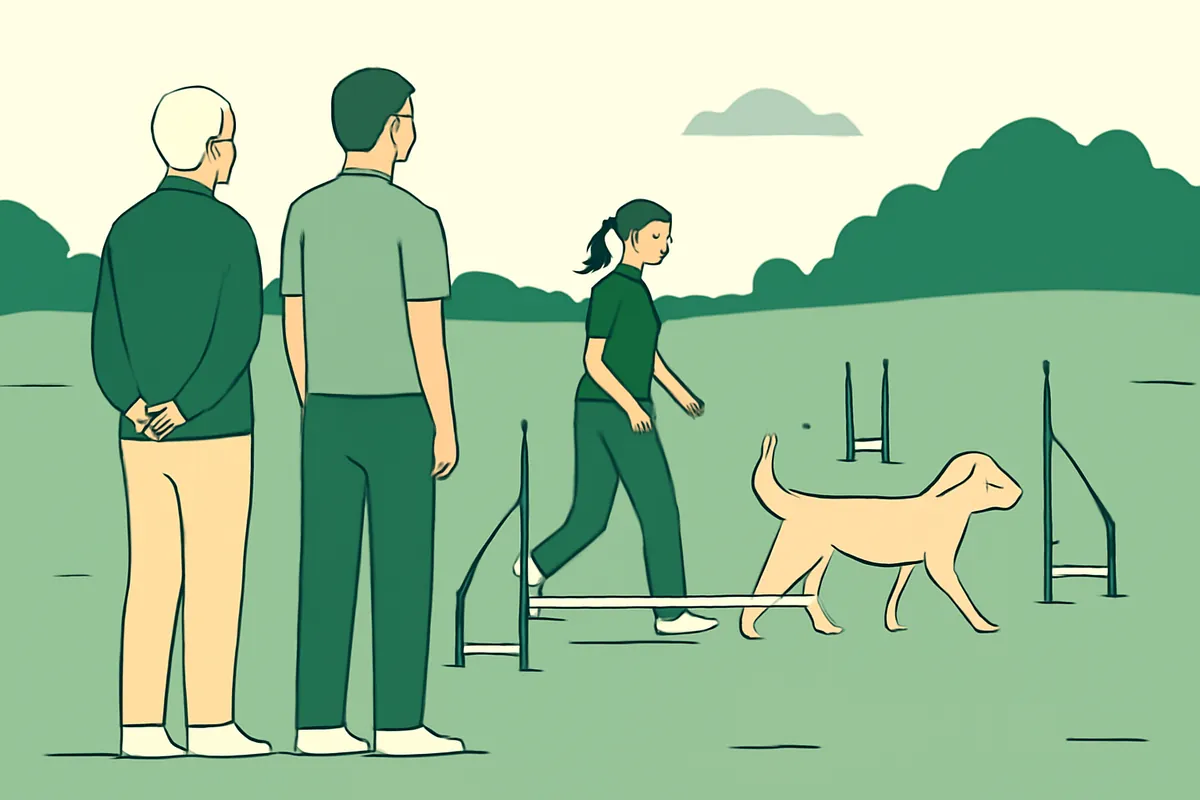
These test what you know, usually in writing. Some are multiple choice; others ask you to write answers to realistic situations.
What the PetCred Agility Coach assessment involves:
- 12 written, scenario-based questions in 60 minutes, marked against a published curriculum covering obstacle training and performance criteria, course design, handling systems, fitness and warm-ups, injury prevention and age-appropriate training, foundation skills, competition rules and coaching people.
- A score by topic within minutes, three attempts included, and the option to buy a personalized course built from the topics you were marked down on.
- A certificate with a public verification link if you pass.
Strengths: fast, flexible and specific about your gaps. Writing an explanation shows your reasoning in a way picking an option does not.
Limits: no one watches you teach a class or handle a dog, and there is no experience requirement. It shows what you know and how you would reason through a situation, not how well you coach in practice. We would rather say that plainly than have a club or client assume otherwise.
Best for: instructors early in their teaching who want to confirm their theory, and experienced instructors who want a quick check of their gaps.
Competition record
Titles and results with your own dogs are not a teaching credential, but students ask about them, and they show you know how to take a dog from foundations to the ring.
Strengths: visible and easy for agility students to understand.
Limits: winning is a different skill from teaching. Some of the best foundation instructors have never competed at the top level, and some top handlers are not natural teachers.
How to choose
Ask yourself four questions:
- Who will look at the credential? Clubs and agility students recognize names from within the sport. Pet owners new to agility are more reassured by a credential they can check online.
- What is your gap? If you know agility well but not learning theory, a general trainer credential helps. If you know training well but not agility, study the sport and check that knowledge with an agility-specific assessment.
- Do you need a practical element? If a club or venue wants to see you teach, only a scheme with a practical assessment, or supervised teaching under a mentor, will do.
- What can you verify? Whatever you hold, make sure a student can check it, and describe it accurately.
Many instructors combine several. A common path is: compete with your own dog, assist and teach under a mentor, study a handling system, confirm the theory with a knowledge assessment, and take part in any scheme your organization offers.
Red flags
Be careful of any agility credential that:
- Is awarded for payment alone, with no assessment of any kind.
- Claims to be "official" or to license you to teach. There is no official license for agility instructors in most places.
- Cannot be verified by a student or venue.
- Encourages harsh methods. Agility is built on dogs that want to play the game.
Related guides
- How to become a dog agility instructor: the complete route, step by step.
- Starting puppies in agility safely: what young dogs can learn and what waits.
- Agility equipment safety and course design: checks, course principles and reading a course.
To see the kind of questions an agility knowledge assessment asks, try our free sample agility coach questions, with model answers.
Written by the PetCred Editorial Team and checked against the published curriculum for this program. Laws and requirements change and differ by place: check local rules before relying on anything legal or regulatory here.
Free course
Dog Agility Coaching Fundamentals: A Free 5-Lesson Course
Five short lessons, a quick check after each, no sign-up. Start now →
More dog agility guides
How to Become a Dog Agility Instructor: A Practical Guide
What a dog agility instructor does, the knowledge the job needs, how to build teaching experience and how agility instructor certification works, step by step.
9 August 2026

Agility Equipment Safety and Course Design
How agility instructors check the ground and equipment, design courses that suit each level, and read a course for the places where dogs get hurt or go wrong.
1 September 2026

Starting Puppies in Agility Safely
What young dogs can safely learn in agility, what waits until they are physically mature, how to run a puppy class and when to send a young dog to its vet.
20 August 2026